As global industries pivot toward sustainability and stricter energy regulations, the demand for high-efficiency cooling components has surged. Traditionally, AC fans were the standard for industrial ventilation, but they are increasingly being replaced by EC (Electronically Commutated) fans.
For engineers in the Commercial Refrigeration, UPS, and HVAC sectors, EC technology represents a significant leap in both performance and power conservation. This article breaks down why EC fans are becoming the mandatory choice for modern thermal design.
An EC cooling fan combines the best of both worlds: it runs on AC power (110V/220V) but utilizes a brushless DC motor and an integrated PCB driver.Unlike traditional AC motors that rely on carbon brushes and copper windings that create friction and heat, EC motors use permanent magnets and electronic switching. This eliminates internal friction and allows the fan to operate at much lower temperatures, which inherently extends the lifespan of the bearings and electronics.
The primary reason for the mass migration to EC technology is the dramatic reduction in power consumption. AC motors often lose up to 50% of their energy as heat. In contrast, EC motors are typically up to 70% more efficient than their AC counterparts.For an industrial facility running hundreds of fans in a 24/7 refrigeration system, the ROI (Return on Investment) of switching to EC can often be measured in months, not years, through reduced electricity bills and lower maintenance costs.
When evaluating cooling solutions for global markets, it is essential to look beyond the initial purchase price. The following data highlights why EC technology is superior in long-term operational environments.
In the table below, we compare standard AC axial fans with modern EC energy-saving fans. Note that the “Speed Regulation” and “Energy Loss” rows are the most critical factors for engineers looking to comply with international energy standards like ErP (Energy-related Products) in Europe.
| Metric | Traditional AC Fan | Modern EC Cooling Fan | Impact on System |
|---|---|---|---|
| Power Conversion | Induction (High Loss) | Electronic (High Efficiency) | EC reduces heat dissipation |
| Speed Control | Limited (Voltage Triac) | Full (0-10V / PWM) | EC allows for precise demand-cooling |
| Energy Consumption | 100% (Baseline) | 30% - 50% | Massive OPEX savings |
| Global Compliance | Low / Declining | High (RoHS, ErP Ready) | Easier market entry for OEMs |
| Operating Temp | High (Internal Friction) | Low (Brushless Design) | Longer equipment lifespan |
Analysis of Data: As shown, the EC fan’s ability to maintain high efficiency even at low speeds is its “killer feature.” While AC fans lose efficiency rapidly when slowed down, EC fans maintain a flat efficiency curve across their entire speed range, making them ideal for variable-load systems like UPS or smart refrigerators.
Because EC fans are electronically controlled, they offer a level of intelligence that AC fans cannot match.
Integrated PWM/0-10V Control: You can precisely ramp speed up or down based on real-time temperature sensors.
Soft Start: EC fans do not suffer from the massive “inrush current” common with AC motors, which protects your power supply and reduces mechanical stress.
Lower Acoustic Profile: By operating more efficiently and eliminating the “hum” of AC induction, EC fans provide a quieter environment for noise-sensitive applications like medical labs and commercial spaces.
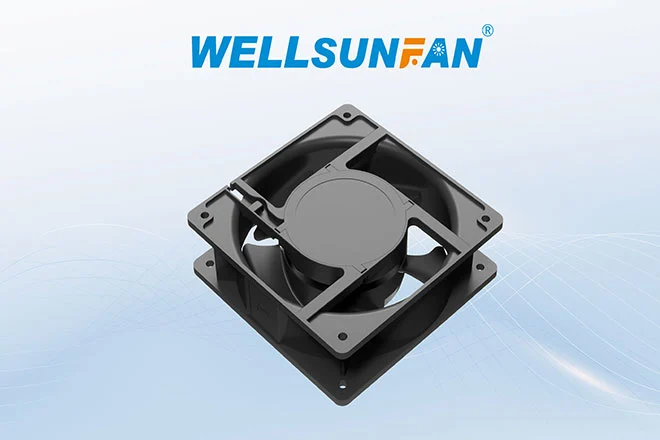
Successfully integrating EC technology into a product line requires a manufacturing partner that understands both the electronics and the mechanics of cooling. Since our founding in Shenzhen in 2011, WELLSUNFAN has been at the forefront of the EC revolution.
Operating from a 10,000-square-meter modern factory with 60 fully automatic injection molding machines and 8 assembly lines, we have the infrastructure to produce up to 3 million fans per month. Our professional R&D team, consisting of over 20 experts, specializes in custom EC driver design, ensuring that our fans meet the specific voltage and control requirements of our global strategic partners.
With high-precision noise testers and air volume pressure testers, we guarantee that our EC fans don’t just meet efficiency standards—they exceed them. Whether you are looking to enter the US, European, or Indian markets, our strategic cooperative relationships with world-renowned enterprises stand as a testament to our “Customer First, Quality Foremost” principle.
The transition to EC technology is no longer an “option”—it is a necessity for companies looking to lead in energy efficiency and performance. By choosing EC, you are investing in a future-proof thermal solution that saves money, reduces noise, and protects the environment.
Ready to upgrade your system to EC energy-saving fans? WELLSUNFAN provides a comprehensive range of EC solutions with customized processing to fit your unique requirements.
Global Export: Proven success in the US, UK, France, and beyond.
Customization: Tailored PWM/0-10V control signals.
 English
 português
 Español
 Deutsch
 русский