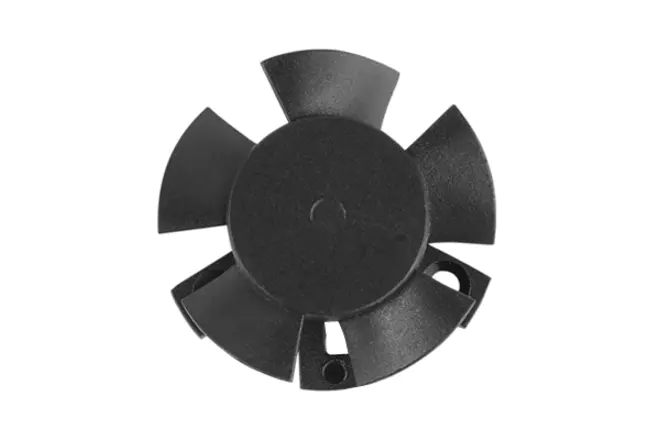
The decision between an Axial Fan and a Centrifugal Fan (commonly referred to as a Blower) is the most fundamental choice an engineer makes. This decision is not merely about size or shape; it is about matching the fan’s aerodynamic profile to the “system impedance” of the device.
Choosing the wrong fan type can lead to insufficient cooling, excessive noise, and premature component failure. This guide breaks down the mechanics, performance trade-offs, and real-world applications of these two distinct cooling technologies.
The primary differentiator between these two categories is the direction of air movement relative to the fan’s intake and motor shaft.
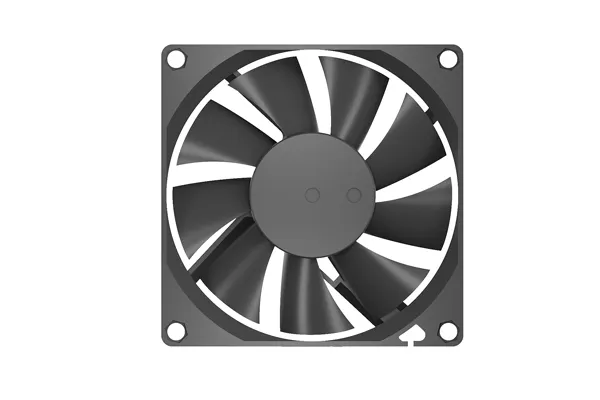
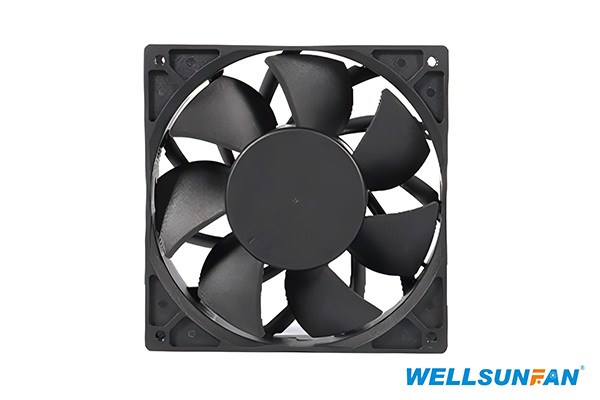
An axial fan functions like a propeller. The blades rotate around an axis, drawing air in and blowing it out in a straight line that is parallel to the shaft.
Common Types: This category includes standard DC Brushless Fans, EC Cooling Fans, and AC Cooling Fans.
Operational Goal: To move a large volume of air (High CFM) with relatively low power consumption in open environments.
A centrifugal fan, or blower, operates by drawing air into the center of the intake and then flinging it outward at a 90-degree angle. The air is compressed and accelerated through a scroll-shaped housing.
Common Types: The most prevalent version in electronics is the DC Blower Fan.
Operational Goal: To generate high static pressure to “push” air through narrow, obstructed, or high-resistance paths.
In engineering terms, selecting a fan is a trade-off between Airflow (Q) and Static Pressure (P). Choosing between an axial and a centrifugal design depends entirely on how much resistance the air will encounter inside your equipment.
The following table provides a technical comparison of the two designs. Note that while axial fans offer superior volume, centrifugal blowers are the only choice for high-impedance systems.
| Engineering Metric | Axial Cooling Fans (DC/EC/AC) | Centrifugal Fans (DC Blower) | Strategic Impact on Design |
|---|---|---|---|
| Air Path | Straight-through (Parallel) | 90-Degree Turn (Perpendicular) | Dictates vent and component placement |
| Max Airflow (CFM) | High | Moderate to Low | Axial is best for ambient enclosure cooling |
| Static Pressure | Low to Moderate | High | Blowers penetrate dense fins and filters |
| Acoustics | Lower at high airflow | Higher at high pressure | Affects user experience and placement |
| Space Efficiency | Standard Square/Round | Scroll / “Snail” Shape | Blowers fit in flat, narrow cavities |
Technical Analysis: As the data suggests, an axial fan—such as a DC Brushless Fan—is most efficient when the air path is clear. However, as the system becomes “dense” with components, an axial fan’s airflow drops significantly. In these high-resistance scenarios, a DC Blower Fan is required because its internal compression allows it to maintain airflow even under significant backpressure.
Different industries have different “impedance profiles,” which dictates whether an axial or centrifugal design is used.
In 3D Printing, the cooling nozzle must focus air into a tiny point on the newly extruded plastic. A standard axial fan would stall against such a small aperture. Therefore, engineers use a DC Blower Fan to generate the necessary static pressure to force air through the cooling duct. Similarly, in Medical Ventilators, air must be pushed through complex tubing and fine filters, making high-pressure blowers the preferred choice.
These systems generate heat across a large surface area of capacitors and transformers. A high-volume DC Axial Fan is the standard here, as it can pull cool air through the front of a rack and exhaust it through the back with maximum energy efficiency. For large-scale industrial units, EC Cooling Fans are increasingly popular due to their ability to move massive amounts of air while consuming 70% less energy than AC fans.
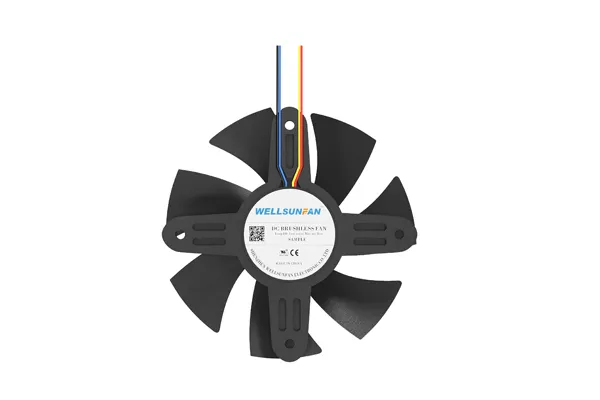
In devices like VR Headsets or handheld medical tools, space is at a premium. Here, engineers often use DC Frameless Fans. These are specialized axial fans that allow the impeller to be integrated directly into the device’s chassis, providing a thin-profile cooling solution that still offers the high-volume benefits of axial airflow.
To make a final decision, engineers look at the P-Q Curve (Pressure vs. Flow).
Low System Resistance: If your enclosure is open, choose an axial fan operating at the bottom-right of the P-Q curve.
High System Resistance: If your air must pass through a dense heatsink or filter, choose a DC Blower Fan that operates effectively at the top-left of the P-Q curve.
Using an axial fan in a high-pressure zone often leads to the “Stall Region,” where the fan creates a lot of noise and vibration but very little actual cooling.
Selecting the correct aerodynamic design is only half the challenge; the other half is ensuring the component is built to survive industrial environments. Since its founding in Shenzhen in 2011, WELLSUNFAN has established itself as a premier manufacturer of both axial and centrifugal technologies.
Operating from a modern 10,000-square-meter factory, we have the infrastructure to support high-precision OEM production. Our facility is equipped with 60 fully automatic injection molding machines, allowing us to produce the high-tolerance scroll housings required for our DC Blower Fan series and the rigid frames for our DC Brushless and EC Axial Fans.
Our professional team of 300 people includes a dedicated R&D department of over 20 experts who use high-precision balancing instruments and noise testers to ensure every product meets strict performance targets. With a monthly production capacity of 3 million fans, WELLSUNFAN supports world-renowned enterprises across the US, Europe, and Asia. From high-speed SMT placement to air volume and pressure testing, we adhere to the principle of “Customer First, Quality Foremost,” ensuring that your critical equipment—whether a UPS, a medical device, or a 3D printer—stays cool and reliable.
The choice between axial and centrifugal fans is a choice between volume and force.
Axial Fans (DC/EC/AC/Frameless): Best for general cooling, high-volume flushing, and energy efficiency in open spaces.
Centrifugal Fans (DC Blower): Best for overcoming high resistance, ducted cooling, and concentrated airflow in dense enclosures.
Not sure if your system requires a high-pressure blower or a high-volume axial fan? WELLSUNFAN provides technical consultation, custom R&D, and verified P-Q curve data to ensure your design is optimized.
 English
 português
 Español
 Deutsch
 русский