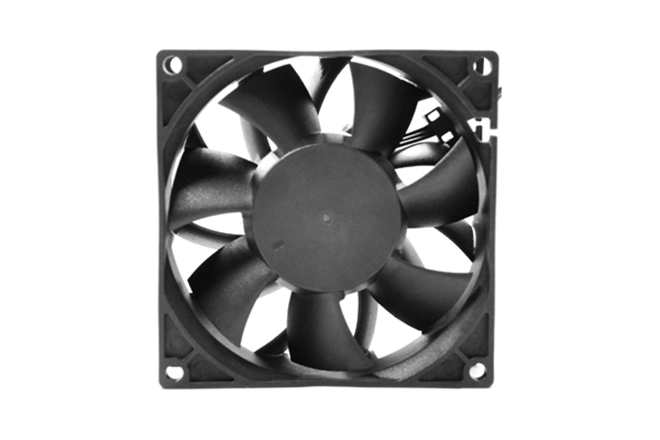
In the world of thermal management, many engineers and buyers make the mistake of choosing a DC cooling fan based solely on its maximum CFM (Cubic Feet per Minute) rating. However, in real-world applications—whether it’s a dense server rack, a medical device, or a 3D printer—airflow does not exist in a vacuum. It must overcome System Impedance.
This guide explores the critical relationship between Airflow and Static Pressure, and how to use performance data to select the perfect cooling solution for your specific enclosure.
To select the right DC cooling fan, we must first define the two forces at play:
Airflow (Q): Measured in CFM or m³/min, this refers to the volume of air the fan moves per unit of time. High airflow is ideal for “open” systems where heat needs to be flushed out of a large space with few obstructions.
Static Pressure (P): Measured in mmH₂O or Pa, this is the pressure the fan exerts to overcome resistance. High static pressure is essential for “closed” or “dense” systems where air must be forced through narrow gaps, filters, or heat sinks.
Every component inside your device—PCBs, wires, filters, and even the fan grill—acts as an obstruction. This resistance is known as system impedance. As impedance increases, the fan’s ability to move air decreases. Understanding this helps engineers avoid “choking” the system by using a high-CFM fan that has zero pressure capability.
Every professional-grade fan comes with a performance curve, often called the P-Q Curve. This graph illustrates the fan’s performance from maximum airflow (zero pressure) to maximum static pressure (zero airflow).
The Operating Point: The “sweet spot” is where your system’s resistance curve intersects with the fan’s P-Q curve.
Stall Region: Selecting a fan that operates in its “stall” region (the dip in the curve) can lead to increased noise, vibration, and reduced motor lifespan. A professional design avoids this zone by matching the fan’s pressure capabilities to the system’s real-world resistance.
Choosing between a standard axial fan and a high-pressure blower requires an understanding of the trade-offs between volume and force. The table below provides a decision-making framework for engineers to match fan types with the specific resistance levels of different industrial applications.
In the data matrix below, we analyze how different obstruction levels dictate the required performance metrics. Note that as the “Obstruction Level” increases, the priority shifts from CFM to Static Pressure to maintain a stable operating temperature.
| Application Environment | Obstruction Level | Priority Metric | Recommended Fan Type | Technical Reasoning |
|---|---|---|---|---|
| Open Cabinet / Ventilation | Low | Max Airflow (CFM) | Standard DC Axial Fan | Low resistance allows for high-volume flushing |
| Dense Servers / Telecom | High | Static Pressure | Dual Rotor / High-Pressure Axial | Dense fins require force to penetrate air gaps |
| 3D Printer Extruder | Very High | Static Pressure | DC Blower Fan (Centrifugal) | Concentrated airflow needed for rapid cooling |
| Medical Lab Equipment | Medium | Balanced P-Q | DC Brushless with PWM | Requires stable airflow at varying RPMs |
| Commercial Refrigerators | Medium | Airflow + IP Rating | EC Energy Saving Fan | Balanced performance with moisture resistance |
Contextual Analysis: For a design engineer, the takeaway is clear: if your device uses high-density components or HEPA filters, you must prioritize fans with a “steeper” P-Q curve (higher static pressure). Conversely, for a large electrical cabinet, a “flatter” curve with higher CFM will provide better ambient cooling.
Founded in Shenzhen in 2011, WELLSUNFAN has established itself as a cornerstone of the global cooling industry. We recognize that high-performance cooling is a science, which is why we operate from a 10,000-square-meter modern manufacturing facility dedicated to the “Quality Foremost” principle.
Our professional team of 300 people includes a specialized R&D department of over 20 engineers who utilize high-precision Air Volume and Pressure Testers to verify the P-Q curves of every fan we produce. This ensures that the data you receive in our technical sheets matches the reality in your equipment. Equipped with 60 fully automatic injection molding machines and 8 assembly lines, we boast a monthly output of 3 million fans. This scale allows us to provide strategic cooperative support to world-renowned enterprises, ensuring that whether you need a standard 40mm fan or a custom high-pressure blower, your order is backed by reliable equipment like noise testers, constant temperature chambers, and ROHS testers. At WELLSUNFAN, we don’t just supply parts; we provide the verified technical strength required for your most critical projects.
To ensure your equipment stays cool, don’t just look at the CFM. Calculate your system’s resistance and find the fan that provides the necessary static pressure to maintain the required airflow. Contact WELLSUNFAN and optimize your thermal design now.
 English
 português
 Español
 Deutsch
 русский